Top 10 Robots in Germany in 2025: Precision, Care & Industrial Genius
Germany’s engineering culture has always prized precision and purpose — and in 2025, that ethos is visible in robots. From collaborative arms that learn at your side to wearable exoskeletons that keep workers healthy, German robotics blends pragmatism with ingenuity. This long, humanized guide walks you through the top 10 robots leading the charge.
Why Germany’s robots matter in 2025
Robots are no longer futuristic curiosities — they’re everyday tools that keep factories humming, help hospitals run, and assist research teams tackling real problems. In Germany, industry-research collaboration (think: Fraunhofer institutes + major manufacturers), a strong focus on manufacturing, and pragmatic design have produced robots that are useful, safe, and widely adopted.
This list focuses on robots that are actively used or shaping adoption across industry, healthcare, and research in 2025 — practical machines you’d expect to meet in factories, care homes, labs, and logistics centers.
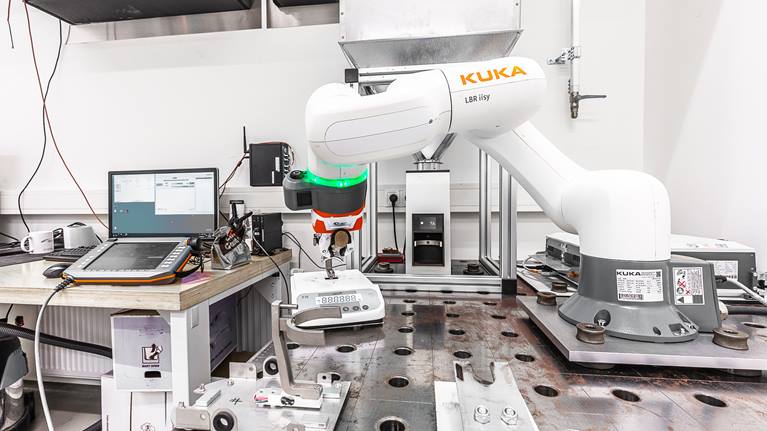
1. KUKA LBR iisy — the cobot that democratizes automation
What it is: A collaborative robot (cobot) designed for easy deployment in small and medium-sized factories. The LBR iisy is lightweight, safe to work near people, and simple to program — it’s built for real production work rather than showcase demos.
Why it's important: KUKA focused on making a cobot that reduces integration time and cost. For European SMEs, that means automating repetitive tasks without a huge engineering project — quicker ROI, less friction, and more resilient production lines.
2. Bosch APAS — the assistant that works beside you
What it is: APAS (Automated Production Assistant) is Bosch’s modular kit for human-robot collaboration. It combines safe arms, mobile platforms, and vision systems to create hybrid work cells where people and robots share tasks.
Why it's important: APAS is designed to be intuitive and certified for collaborative use — making it ideal for quality inspection, small-batch production, and mixed manufacturing environments where flexibility matters.
3. Fraunhofer Care-O-bot family — service robots with heart
What it is: A modular service robot platform developed over years by Fraunhofer researchers. Care-O-bot variants are used for information kiosks, item delivery, and light caregiving tasks in public spaces and healthcare environments.
Why it's important: Fraunhofer emphasizes social acceptance: these robots have expressive faces/displays, safe motion, and adaptable modules so hospitals, museums, and airports can program behaviors that fit their users.
4. Franka Research 3 — the precise, teachable manipulator
What it is: The successor to the Panda — a torque-sensitive, high-precision manipulator favored by research labs and startups. It’s developer-friendly and integrates with ROS 2 for advanced control and machine learning experiments.
Why it's important: Franka’s focus on low-level control and safety makes it perfect for R&D, medical manufacturing, and tasks that require a gentle human touch combined with repeatable precision.
5. German Bionic Cray X — exoskeletons that protect people
What it is: Wearable robotics — exoskeleton suits and assistive frames that reduce strain during lifting and repetitive work. German Bionic’s systems help logistics and manufacturing workers stay healthier and more productive.
Why it's important: These are robotic systems designed to augment humans rather than replace them. They directly reduce injuries, help aging workforces remain employed, and make physical work sustainable.
6. Festo Bionic series — nature-inspired robots with industrial lessons
What it is: Festo’s bionic robots are research-driven prototypes — flying swallows, gliding jellyfish, and soft grippers that inspire new approaches to motion and manipulation used in industry.
Why it's important: Festo’s experimentation informs practical product features — energy-efficient actuation, compliant grippers, and graceful motion that improves safety around people.
7. Siemens SIMATIC + Robot AI — robots integrated into the factory brain
What it is: Siemens combines robots, PLCs, digital twins, and AI in the SIMATIC ecosystem. Robots aren’t isolated actors; they’re data-driven participants in a networked production environment.
Why it's important: Integration with factory IT unlocks predictive maintenance, flexible scheduling, and consistent quality — turning robots into intelligent assets rather than isolated tools.
8. Modular robotics — build what you need, when you need it
What it is: A trend more than a single robot: modular arms, swappable end-effectors, and plug-and-play sensor packs that let factories evolve robots incrementally.
Why it's important: Modularity reduces waste, lowers cost of ownership, and lets smaller companies adopt automation in stages — a crucial enabler for broad adoption.
9. Cognitive & learning robots — Neura MAiRA and friends
What it is: Robots equipped with on-board learning stacks, perception, and natural language interfaces that can learn new tasks by demonstration.
Why it's important: These systems cut programming time dramatically: teach the robot once, and it generalizes to similar tasks — perfect for dynamic production lines.
10. Precision micro-assembly & niche specialists — the unsung heroes
What it is: Ultra-precise arms and inspection machines used in medical device assembly, semiconductor fabs, and watchmaking — high accuracy, cleanroom-ready, and extremely reliable.
Why it's important: These niche robots support industries where quality and tolerance matter; they don’t make headlines but they keep critical supply chains running.
Major trends shaping Germany’s robotics in 2025
- Human-centered automation: Augmentation (exoskeletons, cobots) over replacement.
- Integration & data: Robots as part of the factory brain — digital twins, predictive maintenance.
- Modularity: Shorter upgrade cycles, lower capital risk for SMEs.
- Bionic inspiration: Soft and bio-inspired designs that improve safety and efficiency.
Challenges to keep an eye on
Cost of high-precision components, the need for skilled robotics engineers, and clear regulation around data use in public-facing robots are the main constraints. Governments and industry bodies are working on reskilling programs and standards to address these gaps.
How to adopt robotics in your business (practical checklist)
- Identify a repetitive, high-cost task and measure baseline effort.
- Start with a pilot using a cobot or modular kit — measure cycle time and error rate.
- Train staff and prioritize safety — human factors matter.
- Integrate with factory IT (MES/PLCs) to get data ROI.
- Scale gradually — modular upgrades keep CAPEX manageable.
Comments
Post a Comment