🤖 The Iron Tsar: Top 10 Robots Driving Russia’s Tech Revolution in 2025
Date: November 16, 2025
🚀 Introduction
The year is 2025, and across the vast landscape of Russia, a silent, powerful revolution is underway—the Robotics Revolution.
Long known for its engineering prowess in aerospace and heavy industry, Russia is now making an aggressive pivot to become a major global player in robotics. Bolstered by substantial government subsidies, national projects like "Means of Production and Automation," and a surging demand for efficiency across key sectors, the nation's robotics market is predicted to see double-digit growth, aiming to drastically increase its robotization density by the end of the decade. Analysts project a Compound Annual Growth Rate (CAGR) of $12.35\%$ for the Russian robotics market between 2025 and 2030, highlighting the accelerating pace of change.
This isn't just about catching up; it’s about establishing technological sovereignty and preparing for the future of Industry 4.0. From the clang of newly automated automotive lines to the quiet whirring of service robots in public spaces, the impact is undeniable.
But which machines are truly leading the charge? We've delved into the most significant projects, groundbreaking innovations, and massive industrial deployments to bring you the definitive list. This is a mix of established industrial powerhouses and emerging AI-driven platforms that are fundamentally redefining Russian manufacturing, security, and services.
Get ready to meet the new 'Iron Tsar'—the Top 10 Robots in Russia in 2025.
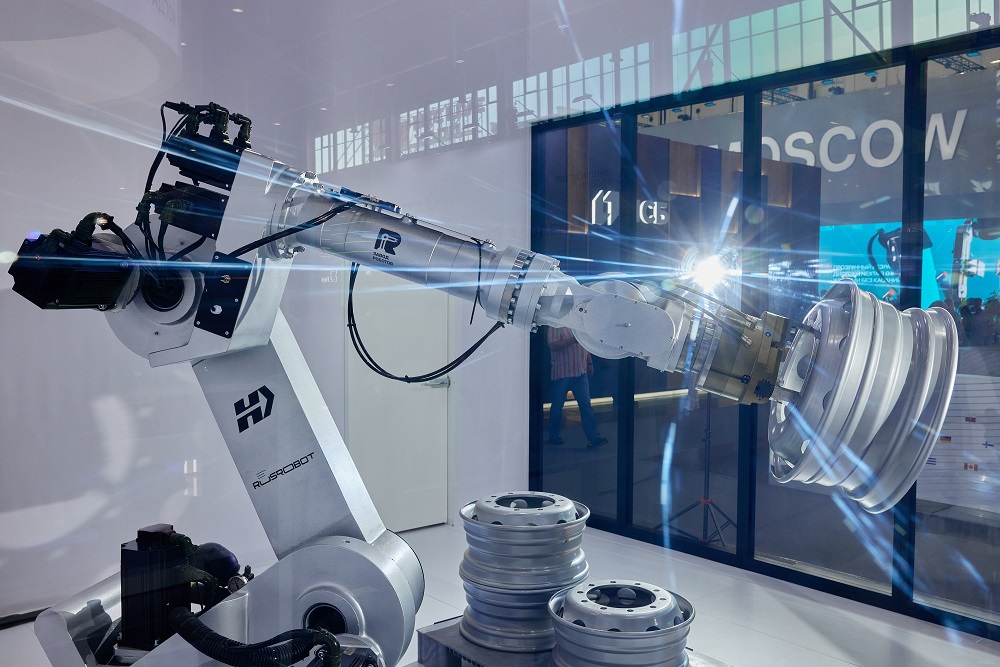
🏭 The Industrial Titans: The Backbone of Russian Automation
Industrial robots remain the undisputed heavyweights of Russia's robotics market. They are the core focus of the government's push for automation, particularly in sectors facing workforce shortages and intense global competition. This sector receives the highest volume of state support through preferential leasing and industrial development funds.
1. RusRobot RR-120-2900: The Domestic Industrial Workhorse
While many Russian factories traditionally relied on foreign brands like FANUC and ABB, the homegrown RusRobot RR-120-2900 series is rapidly changing that. Developed by Russian Robot LLC and produced at the Robot Plant in Chelyabinsk, this 6-axis industrial manipulator is designed to be the go-to domestic alternative, offering a payload capacity of $120$ kg and a reach of $2900$ mm.
Key Application: Heavy-duty operations like arc and spot welding, palletizing, component transfer, and CNC machine tending. It is particularly valued for its integration with domestic control systems.
Why It Matters in 2025: It's the face of Russia’s drive for technological independence. The Chelyabinsk region is rapidly scaling up its Industrial Robotics Centre—a unique science and production hub—to integrate these robots into Ural industry on a turnkey basis. Its presence in key manufacturing hubs, including large deployments for new truck production lines and at the Chelyabinsk Forge-and-Press Plant, solidifies its rank as a pivotal industrial player. The government targets a $50\%$ share of domestic robots in new installations by 2030, a goal the RR-120 is central to achieving.
Technical Edge: Uses an adaptive control system that minimizes vibrations during high-speed movements, crucial for welding precision.
The introduction of industrial robots has proven to be an instant productivity booster. Companies like the Klimovsky Pipe Plant have doubled production output after integrating complex robotic cells for material processing and quality inspection.
2. The AvtoVAZ Welding & Painting Fleet (Mixed OEM/Domestic Integration)
The automotive sector remains the single largest consumer of industrial robots globally, and Russia is no exception. Companies like AvtoVAZ (Lada) and UAZ (Sollers Group) have made massive investments in 2025 to overhaul their assembly lines. While this often involves international equipment (as state corporations were permitted to purchase foreign tech to accelerate the national project), the sheer scale of deployment and integration of Russian-developed software earns it a spot.
Key Application: High-precision, high-volume tasks like car body welding (up to 4,000 spot welds per chassis), component cutting, glass gluing, and automated painting with volatile organic compound (VOC) reduction.
Why It Matters in 2025: The new welding workshops launched by AvtoVAZ, which house over 100 robots in a single complex, and the highly automated engine production lines at Sollers, represent the tipping point for industrial automation in the country. This systemic shift signals a commitment to global manufacturing standards that previous manual methods simply couldn't achieve, driving quality and efficiency.
3. Severstal’s Metallurgical Robots (Customized Heavy Automation)
Russia’s industrial power is rooted in its natural resources and metallurgy. Severstal, one of the nation's leading steel and mining companies, committed over 5 billion rubles in 2025 to robotic automation and digital transformation. This highlights the move from general-purpose industrial robots to highly customized, rugged solutions for extreme environments.
Key Application: Automated inspection of hot-rolled metal ($>700^\circ C$), spectrometer analysis of molten metal samples, automated brick laying in furnaces, and hazardous material handling in extreme heat, dust, and vibration conditions.
Why It Matters in 2025: It showcases the trend towards integrating robotics in the most challenging and dangerous environments. These aren't just assembly-line robots; they are specialized machines designed with enhanced heat shielding and hardened sensors to increase worker safety, improve material yield by minimizing human error, and boost material efficiency in a sector that is the bedrock of the Russian economy.
💂 The Service & Security Sentinels: Robots for People and Protection
Beyond the factory floor, a new wave of robots is entering public spaces, logistics, and, critically, the defense sector, reflecting the global trend toward versatile, AI-powered systems.
4. Promobot V.4: The Humanoid of Public Service
The name Promobot is synonymous with Russian service robotics. Though it faces international competition, Promobot has aggressively pursued its niche in interactive, customer-facing roles. The latest V.4 model, rolled out in 2025, features improved facial recognition, greater emotional expressiveness, and a tighter integration with Russian-language large language models (LLMs) for superior conversational depth.
Key Application: Customer service, interactive consultation, and information dispensing in retail (e.g., Azbuka Vkusa stores), banking, airports, and museums (e.g., the State Hermitage Museum).
Why It Matters in 2025: Promobot’s successful, high-visibility deployment in public and commercial spaces serves as the main domestic example of how robotics is transforming service interactions. With hundreds deployed, they are the most recognizable robot brand to the Russian public, making robotics tangible for the average citizen and driving acceptance of AI-powered systems.
5. Marker (NPO Android Technology): The Autonomous Ground System
The Marker robotic complex is arguably the most publicized Russian ground drone platform. Designed by NPO Android Technology, this machine is a modular, tracked, or wheeled unmanned ground vehicle (UGV) capable of operating autonomously for extended periods using advanced neural network processing for pathfinding and target identification. The project entered serial manufacturing in early 2025, marking a significant milestone.
Key Application: Defense, reconnaissance (with thermal and optical sensors), and logistics support, including the capacity to carry heavy payloads or specialized modules like the Kornet Anti-Tank Guided Missile.
Why It Matters in 2025: It represents the highest level of domestic autonomy in the defense sphere. The system’s ability to function as a "loyal wingman" for infantry and its advanced control systems—which allow for distributed, user-friendly operation by a single operator controlling multiple units—make it a critical part of modernizing military and security operations.
6. AIDOL: The Ambitious Humanoid (and a Learning Lesson)
The announcement and subsequent partial launch of the AIDOL humanoid robot in late 2025 was one of the most highly-anticipated—and widely reported—events of the year. Developed by the startup Idol as the flagship of the New Technological Coalition, AIDOL promises a fully anthropomorphic, AI-powered system capable of stable bipedal walking, fine object manipulation, and fluid communication.
Key Application: Potential for next-generation manufacturing, complex logistics, and interactive service roles where a human form factor is beneficial (e.g., operating human-designed tools).
Why It Matters in 2025: Despite a widely publicized developmental stumble during a live demonstration (a powerful reminder of the challenges in dynamic bipedal control), AIDOL represents the future-forward aspirations of Russian robotics. It forces domestic manufacturers to accelerate their R&D in complex dynamic control, advanced manipulation, and sophisticated generative AI integration to compete with international leaders. Its existence drives investment and attention in the highly competitive humanoid space.
🔬 The Specialized Innovators: Niche, High-Impact Solutions
The final tier of leading robots highlights the deep integration of robotics into complex, specialized sectors like logistics, extreme environment monitoring, and agriculture—areas critical to Russian infrastructure.
7. Yandex.Rover and Sber's Delivery Bots: The Last-Mile Logistics Revolution
While technically different projects from competing tech giants, the collective deployment of autonomous wheeled delivery robots from Yandex (Yandex.Rover) and Sber (SberDevice) forms one of the most significant civilian robotic trends of 2025. These sidewalk-sized robots use advanced Lidar and computer vision for navigating urban environments.
Key Application: Last-mile delivery of groceries, documents, and small packages in urban areas, university campuses, and techno-parks.
Why It Matters in 2025: The increasing scale of their deployment in Moscow, Innopolis, and St. Petersburg has validated the commercial viability of autonomous logistics in a challenging climate (dealing with snow and ice). This infrastructure sets the stage for much larger autonomous transport systems in the near future and directly addresses the high costs of courier services.
8. Robotics for Extreme Heat & Cold: The Inspection Pioneer
Scientists at the Southwest Ural’s University and institutes in Siberia have jointly developed a highly specialized line of inspection and maintenance robots designed to operate in Russia's two most common extreme conditions: the $1000^\circ C+$ heat of metallurgical processes and the $-50^\circ C$ cold of Arctic infrastructure.
Key Application: Remote inspection, monitoring of pipeline integrity in permafrost, and maintenance in extremely hot and hazardous industrial environments (e.g., detecting defects in continuous casting).
Why It Matters in 2025: This development tackles critical operational pain points in Russia’s resource-heavy industries. By automating tasks in conditions where human presence is impossible or costly, it unlocks new levels of efficiency and reduces risks in Arctic development and core industrial processes, proving that Russian innovation can handle the country's unique geographical and industrial challenges.
9. DevDroid's Droid TW 12.7 UGV: Combat Logistics and Defense
The Droid TW 12.7 is an Unmanned Ground Vehicle (UGV) that has recently seen high-profile deployment in defense and security scenarios. Equipped with a heavy machine gun combat module ($12.7$ mm caliber) or equivalent payload, the system focuses on supporting infantry and holding positions in dangerous zones.
Key Application: Unmanned strike, perimeter defense, and logistics for ground forces, providing cover and surveillance while minimizing human risk.
Why It Matters in 2025: Its success in autonomous combat logistics, effectively replacing human infantry in high-risk areas for extended periods, showcases the rapid maturity of domestic military robotics, driven by a national mandate for autonomous defense systems. The system's user-friendly, distributable control software is also a key factor in its increased adoption by security forces.
10. Ruslakto's Automated Dairy Robots: The Agri-Tech Pioneer
The agricultural sector is also seeing robotic integration, albeit more quietly than defense or manufacturing. Ruslakto, a major milk producer, invested heavily in industrial and specialized mobile robots for milk production in 2025, utilizing a mix of imported systems and Russian sensor/AI control platforms. This move is indicative of a broader, crucial shift in Russian agriculture toward automation to boost yield and quality.
Key Application: Automated milking (robotic arms attached to cows), precise cattle feeding based on individual health metrics, automated barn cleaning, and continuous health monitoring/quality control in large-scale dairy and livestock farming.
Why It Matters in 2025: While industrial robots often hog the spotlight, this points to the emerging, high-value segment of agricultural robotics in Russia. Automating farm work helps counter persistent labor shortages in rural areas and ensures higher, more consistent quality and volume in the nation’s vital food production sector, ensuring food security.
💡 The Future is Automated
The list above is not just a showcase of cool tech; it's a window into the strategic direction of an entire nation's industrial and technological policy.
The theme of Russian robotics in 2025 is clear: localization, vertical integration, and large-scale industrial deployment. Massive government subsidies (including preferential leasing and cashback programs covering up to $50\%$ of costs) have created an aggressive domestic market for automation. Whether it's the welding arms in a new car factory or the UGV providing logistics support, the integration of robots is driven by twin necessities: the global race for Industry 4.0 dominance and the need for localized, resilient supply chains that can operate independently.
The path is not without its dramatic stumbles, as the AIDOL debut showed, but these moments are often the catalysts for the next leap in innovation. As new manufacturing centers open with the goal of creating Russia's first "dark" (fully automated, human-free) workshops, the Top 10 list will surely evolve, especially as domestic AI companies begin integrating their advanced models directly into robotic control systems.
The Iron Tsar is on the move, and the sound of whirring servos is the new beat of Russian industry.
Comments
Post a Comment